Can Philippine buildings withstand a major earthquake?
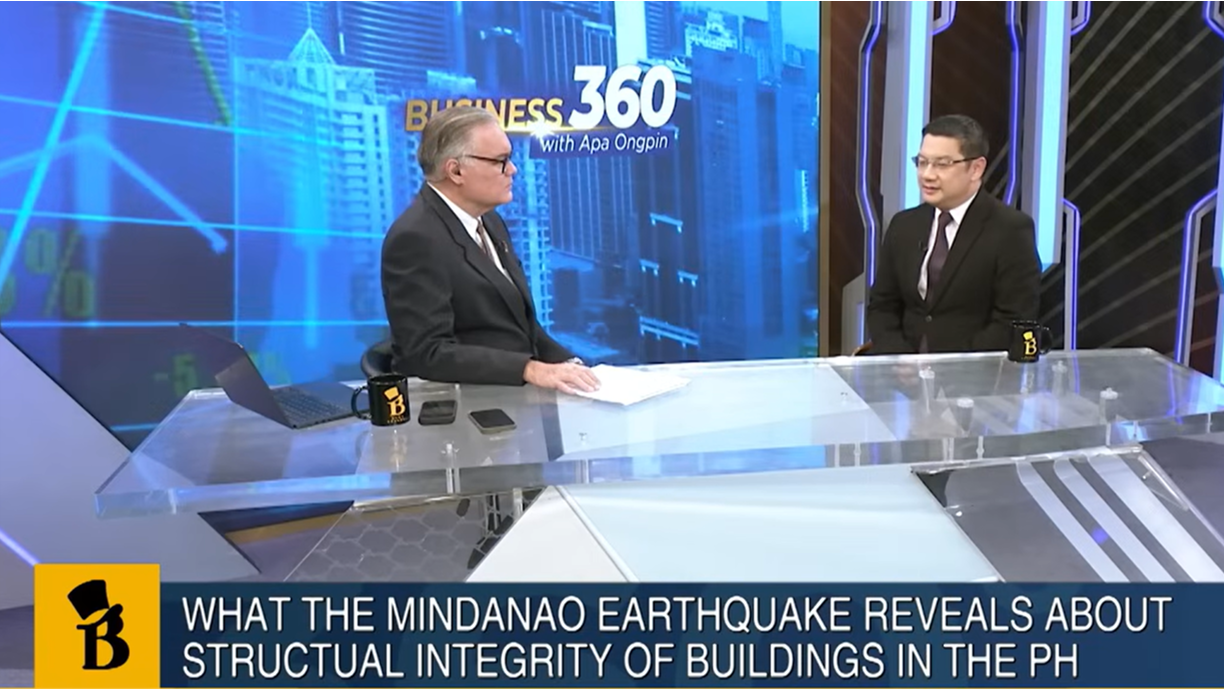
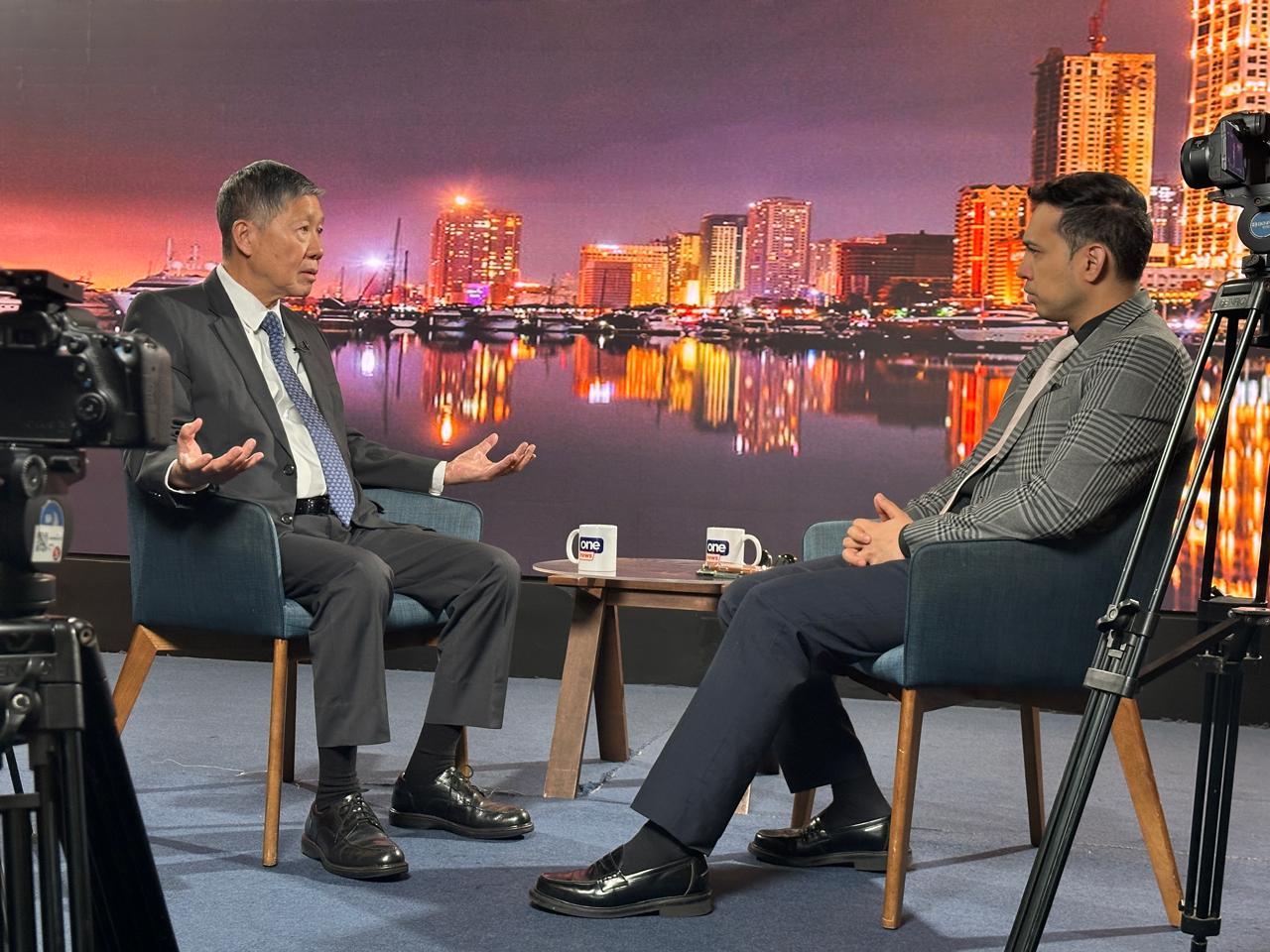
SteelAsia Executive Vice President & Co-Chief Operating Officer Pek Hoong Chong was the live studio guest in Business 360 hosted by Apa Ongpin on the Bilyonaryo News Channel. He discussed construction standards, building safety, earthquake resilience, sustainable steel production, and the lessons the Philippines must learn following the recent Mindanao quake.
Watch the full interview here:
Transcript:
Apa Ongpin: As authorities assess the damage from the powerful Mindanao earthquake, questions are mounting over whether buildings in the country can withstand major tremors. For perspective, we bring in SteelAsia COO Peck Hoong Chong. Welcome to Business 360, Mr. Chong.
Pek Hoong Chong: Thank you, Apa. Thanks for inviting me.
AO: Let's talk a little bit in as much layman's terms as we can gather. Basic engineering tells us that reinforced concrete construction uses concrete for compressive strength and steel rebars for tensile strength. Earthquakes primarily test tensile strength because the movement of the ground creates bending and twisting pressures on the steel.
Thus, the quality of steel rebars is critical in earthquakes. Is this correct?
PHC: You are absolutely right, Apa. Steel actually is very critical for structural integrity of buildings.
In fact, steel in the Philippines follows the Philippine national standards. And the standards for rebar, which is called PNS-49, has just been reviewed and updated just about two months ago. This standard actually removes all the non-seismic steel rebar from the Philippine National Standard because they are simply not safe enough for the Philippines.
AO: They're obsolete.
PHC: That's right. So right now, the industry is also calling for the DTI, the Department of Industry, to expeditiously implement the standard so that all buildings built in the Philippines will be much safer going forward.
AO: The collapses of the buildings in the recent Mindanao earthquake have raised concerns about substandard rebars. Can you tell me about this concern?
PHC: Yes. Rebars are so critical for these buildings. You need a lot of steel for each construction. Unfortunately, you just need the weakest link to fail and buildings can collapse.
We have seen buildings that use a mix of good steel and not so good steel. Unfortunately, during earthquakes or during other forms of disasters, we have seen building collapses that cause fatalities recently in Mindanao. We have also experienced something similar in Angeles, Pampanga, recently in Bogo, Cebu, late last year. Actually, even in our neighbouring Bangkok, Thailand, last year in March, they also experienced a quick 30-storey building under construction collapse, taking almost 100 lives with them.
AO: You know, the interesting thing about the video we saw from Mindanao was that it was actually smaller buildings that collapsed, like three, four storeys. The tall buildings were fine. Why is that?
PHC: Various factors can cause the integrity of a building and for the buildings to fail. Substandard steel being one of them, construction quality, construction design, but I'm not an expert in the whole field of seismic engineering. But let's say when it comes to steel, substandard steel, according to the Philippine Iron and Steel Institute research found more than 91% of the substandard steel in the country are made by induction furnaces. There are more than 30 induction furnaces in the country.
Induction furnace is actually a technology that's banned in China back in 2017 for construction steel. What happened is, in China, through a series of major earthquakes in Sichuan Province, China, claimed nearly 90,000 lives, and they found induction furnace steel in the wreckage, in the rubble. Initially, the government was trying to stop the steel from being used, and in fact, the Chinese government also found difficulties enforcing it because the local government was not supporting.
Then, in 2017, finally, they took a stern action by disconnecting power supply and dismantled the Chinese induction furnace equipment from various many, many factories in China. More than 100 million tons of steel… Induction furnace steel factories were dismantled. Unfortunately, some of these found their way to Southeast Asia.
AO: In particular to the Philippines.
PHC: Correct. Unfortunately, in the Philippines.
In fact, in 2018, the ASEAN Iron and Steel Council actually called upon all the ASEAN national governments to stop and prevent the induction furnace equipment from entering the country, to avoid the kind of mass fatalities like in Sichuan, China. We're talking about so many, nearly 100,000 deaths there, and this is not yet implemented in the Philippines.
AO: I imagine that the Department of Trade and Industry Board of Investments was happy to welcome these steel mills because it's foreign direct investment.
PHC: I can't speak on behalf of the DTI, of course, but I believe authorities are conscious and aware on the relocation of these induction furnaces from China to Southeast Asia, including the Philippines. We have been bringing about the awareness of the flaws of this technology for seismically active countries like the Philippines.
Because not just China—in Japan and Taiwan, which are also very earthquake prone like the Philippines, this technology is not used there. This technology simply cannot produce the steel that can meet seismic conditions. So hence, we're talking about huge countries in the region not allowing induction furnace to produce construction steel.
AO: I know you know who these plants are and where they are in the Philippines, but I'm not going to ask you to name names.
PHC: There are 30 of them in the country.
AO: I guess we really need to pressure someone to decommission these plants or at least make sure that they're not allowed to sell rebars, construction steel.
PHC: Actually, induction furnace technology is a very good technology to produce machine parts. They are using alloys as their raw material and they produce very high precision machine parts used by the industries. So in that sense, the technology itself is not the problem.
The problem, it's more like it should not be used to produce construction steel using steel scrap, because the technology does not have capability to remove impurities. Hence, if you put impurities in there, it's a bit of a garbage in, garbage out kind of process. You put steel scrap with a lot of impurities, you get steel with very low and inconsistent quality as a product.
AO: SteelAsia actually has been vocal about this issue for years now. I mean, it's well before this earthquake, you already were raising the alarm about this induction furnace rebars.
PHC: As mentioned, Apa, the whole ASEAN Iron and Steel Council, of which the Philippines is part of, are actually very concerned on this technology. So we can see like in Indonesia, they have officially banned the technology for all government projects, because they also feel that it's not safe enough. And we are always highlighting that the Philippine government should take a serious look into this technology.
AO: The Department of Trade and Industry, they're responsible for these product standards, right? The Product Standards Bureau is an attached agency. Do they have adequate testing facilities in the country to test these rebars and make sure they meet PNS-49?
PHC: Actually, both the Bureau of Philippine Standards, as well as affiliated agencies of the DOST, Department of Science and Technology, they have well-equipped laboratories, testing laboratories in Luzon. But perhaps in Vis-Min, it would be good for more facilities to be added.
AO: In other words, they don't have any in Vis-Min.
LPHC: Less in Vis-Min. So hence, we hope the government also will be investing in such facilities. We understand that DOST is already looking into this.
AO: Our perception is that compliance with building codes is under the authority of local government units, essentially city engineers, under the supervision, of course, of the Department of Public Works and Highways. Has this system proven to be adequate? The collapse of the structures in Mindanao, the recent earthquake, seems to undermine our confidence in this system.
PHC: Okay, so there is this National Building Code of the Philippines, which is actually a law. But it makes technical reference to the National Structural Code of the Philippines, which is like the technical specifications to achieve the legal requirements of the Building Code. The system, the enforcement of this, actually, is an inter-agency task. It's a big task. You mentioned about LGU working with DILG, but DTI is involved, DPWH is involved, other associated agencies are involved. So I guess it is not something we are, let's say, fully aware of all the details. But we trust that many government officials are looking seriously in the light of all these disasters that the country is facing.
AO: Yeah, they better, because this is their responsibility, you know. The National Building Code itself, Presidential Decree 1096, was signed by President Ferdinand Marcos Sr. in 1977. It was updated by revised implementing rules and regulations in 2004.
PD 1096, as far as we understand, requires structures within a two-kilometer radius of the epicenter to be able to withstand an earthquake of up to magnitude 7. The Mindanao earthquake was measured at magnitude 7.8. Should we be revising this Building Code and the structural code given that current technology, particularly computer modeling, now allows us to design much stronger structures than in 1977?
PHC: We are aware of the DPWH is actively and urgently reviewing the National Building Code of the Philippines. And also, the National Structural Code of the Philippines is also being updated by the Association of Structural Steel Engineers of the Philippines, the ASEP. SteelAsia and, I think, the rest of our steel industry are very supportive of these actions because we believe this is what the country needs. And I'm quite sure my industry peers and we will be very pleased to support in any way that we can. And you know, if not moral support, technical support, because we believe the country really needs to learn from the lesson and hopefully avoid these costly disasters in the future.
AO: SteelAsia is known in the industry for promoting and achieving high sustainability. Is it true that the substandard steel bars are being produced by competitors? In other words, these induction furnaces under highly pollutive conditions?
PCH: Thank you for your complementary words on SteelAsia's sustainability efforts. We certainly always try our best to maintain a high level in sustainability.
On the part on the rest of the steel industry, I think each steel plant has its own systems to manage in terms of sustainability. We are really not in the best position to comment on them.
AO: Since we do not have iron ore resources in the Philippines, recycled steel has traditionally been a source of raw material. Does SteelAsia recycle steel? And is the process more sustainable than imports?
PHC: Yes. In fact, we recycle steel with 100% renewable energy in Calaca, Batangas. This is one of the greenest steel in the world, as measured by DNV of Norway. Yes, recycling definitely being part of the circular economy and also generate very low carbon footprint is actually the most sustainable way to make steel as compared to the traditional iron ore with coal.
AO: Do you have enough supply of scrap here to feed Calaca?
PHC: Yes, Calaca actually works on 100% domestic scrap.
AO: Oh, fantastic.
PHC: In fact, the Philippines is exporting scrap. Can you imagine it? We're exporting scrap and we are importing finished steel at much higher value. So, it really doesn't make sense. And what SteelAsia will be doing in the coming years is really to change that.
AO: Import substitution.
PHC: Import substitution, making it in the Philippines. We will convert the exports into high quality steel locally and creating thousands of jobs for Filipinos.
AO: So, just last question: What has the earthquake taught us? Where do we need to go from here?
PHC: In our honest opinion, we should learn from other countries' mistake. China suffered 90,000 deaths from earthquakes and they found induction furnace steel used in their construction and they banned it. I think we should learn from it.
We don't want to suffer from so many deaths in our own country. And the country should seriously look into not using induction furnace for construction steel and just use it for what it's made for, which is making industrial parts, which the country's industries actually need.
AO: Well, that's great. Thank you, SteelAsia COO, Pek Hoong Chong.
PHC: Thank you, Apa.#